No one is surprised when an oldtimer tells an often repeated tale. And so, I must repeat the well-worn story of the unfortunate passing of the Franklinia (Franklinia alatamaha) in the garden and its eventual replacement with a Gordlinia ( x Gordlinia grandiflora). Tell me if you’ve heard this one before, but I hope to spice this telling with new (and probably truthful) details.

The precise timing of the acquisition of the Franklinia is uncertain, though it was at a time when the rear garden contained a tiny fraction of the plants that have accumulated in recent decades. I recall seeing the tree for the first time in my distant memory, lining a field along with several others in fertile bottom land in the North Carolina mountains. Bouncing along in his pickup, I asked the nursery owner, Sammy, to identify this small tree with glossy leaves and large buds cracking open to white flowers in mid-July.
I was pleased but surprised to hear “Franklinia,” a tree rarely found in the nursery trade. At the time, three decades ago (we’ll suppose since I’m guessing), I’d never seen one in a nursery and never again saw one. Of course, my obsession with plants is not new, so I had to have one, with a few more to be available for customers.

I will not stretch the story unnecessarily longer by going into the fascinating history of John and William Bartram discovering the tree in 1765 (no, I was not along for the trip), but this only added to my curiousity in obtaining one for the garden.
In the still developing rear garden, there was no trouble finding a spot to plant Franklinia at the corner of the garden’s shed. Here, it thrived for years, growing tall with open branching. White, camellia-like blooms opened by midsummer and occasionally the brilliant autumn foliage would intersect with the last fading flowers.
But, the Franklinia begin to decline. A mostly dormant spring beneath the shed came to life with the surrounding soil becoming persistently damp. While the tree had been carefree, three years into its decline, I reluctantly gave up and chopped it out.
Plants come and go in the garden. Of course, there are many more that flourish than perish, and most casualties are barely missed. But ones that are favorites and ones with stories are mourned, and as you are witnessing, never forgotten.
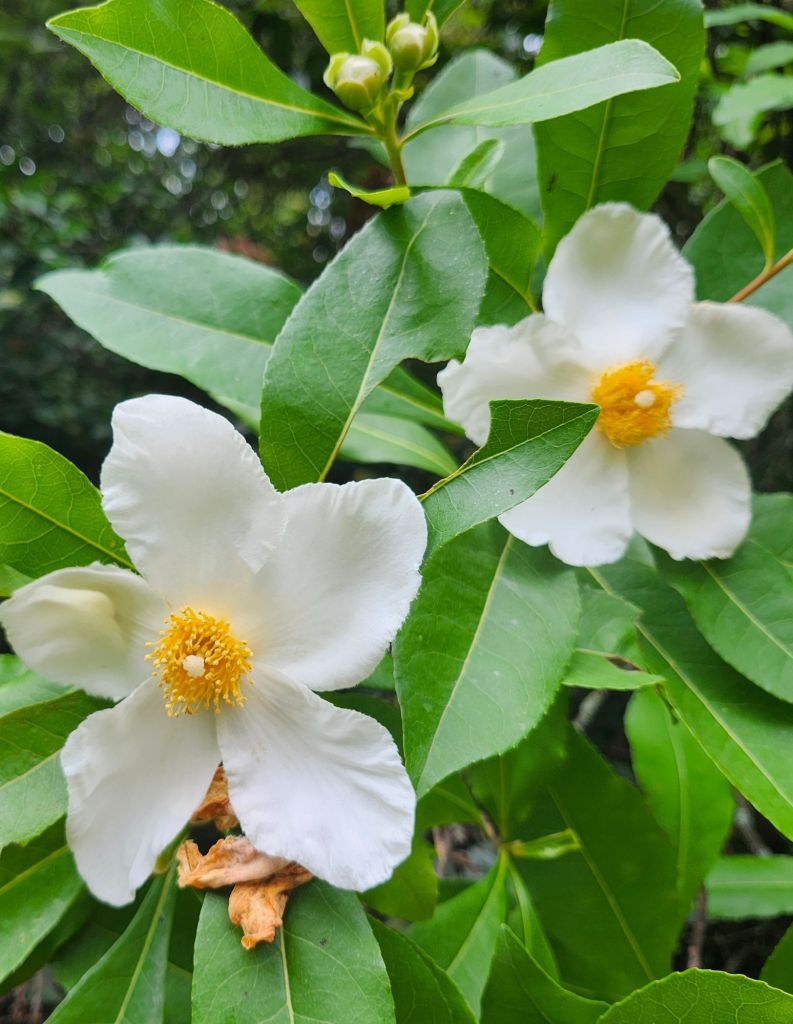
In any case, the search began for a replacement, but none of substantial size could be found. No surprise. But then, I bumped into several containers of Gordlinia (x Gordlinia grandiflora) stashed out of the way at a nursery I’d visited dozens of times. The flowers in mid-July, nearly identical to Franklinia’s, caught my eye, and after a moment’s research, several were mine.
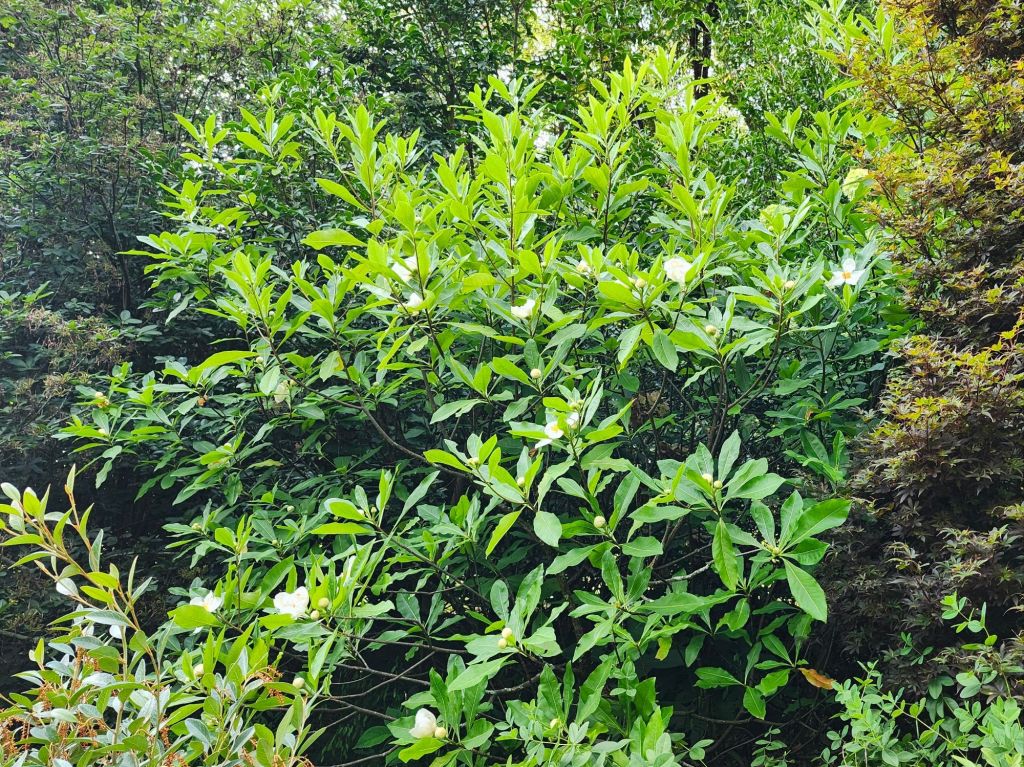
Gordlinia is a cross between Franklinia and the shrubby gordonia, so while its flowers and foliage are similar, it grows as an upright shrub rather than a tree. The ones I purchased were destined for the dump, I suspect, so I planted the trio together to disguise their awkward shape.

The new clump of young trees was planted in a drier spot, with a yellow-twigged dogwood eventually taking Franklinia’s spot. While gordlinia is a wonderful addition to the garden, it is not a Franklinia. Its flowers are nearly identical, but its leaves are less glossy with autumn color far less attractive. It is evergreen, at least mostly so since leaves often turn an unattractive brown by midwinter. They are eventually pushed off with new spring growth.
So, a treasured Franklinia was enjoyed for a decade or more, then followed by heartache as the tree perished. There were high hopes followed by the slight disappointment that gordlinia did not match the lost Franklinia. But, this is gardening. Get over it and move on.
 Ramblin' through Dave's Garden
My experience with Franklinia echos yours. I planted one about 20 or 30 years ago, and really liked it. But then it, too, started a decline. I did some research on it, and the consensus was that this often happened and there was no treatment available that would cure this disease. That’s probably why the Franklinia is so rare – it simply has trouble surviving.
I am fortunate to have suffered only a few loses of favored trees. Loses of smaller plants are numerous.