I’m overjoyed that recent storms have at least temporarily broken our lengthy drought, but high winds have broken heavily weighted branch tips of the bigleaf magnolia (Magnolia macrophylla) and a tulip poplar (Liriodendron tulipifera) that borders the garden. Both trees are relatively soft-wooded and prone to damage, but both are marvelous trees. If such a thing existed, a dwarf tulip poplar would be a gem with low branches more readily displaying its splendid blooms.
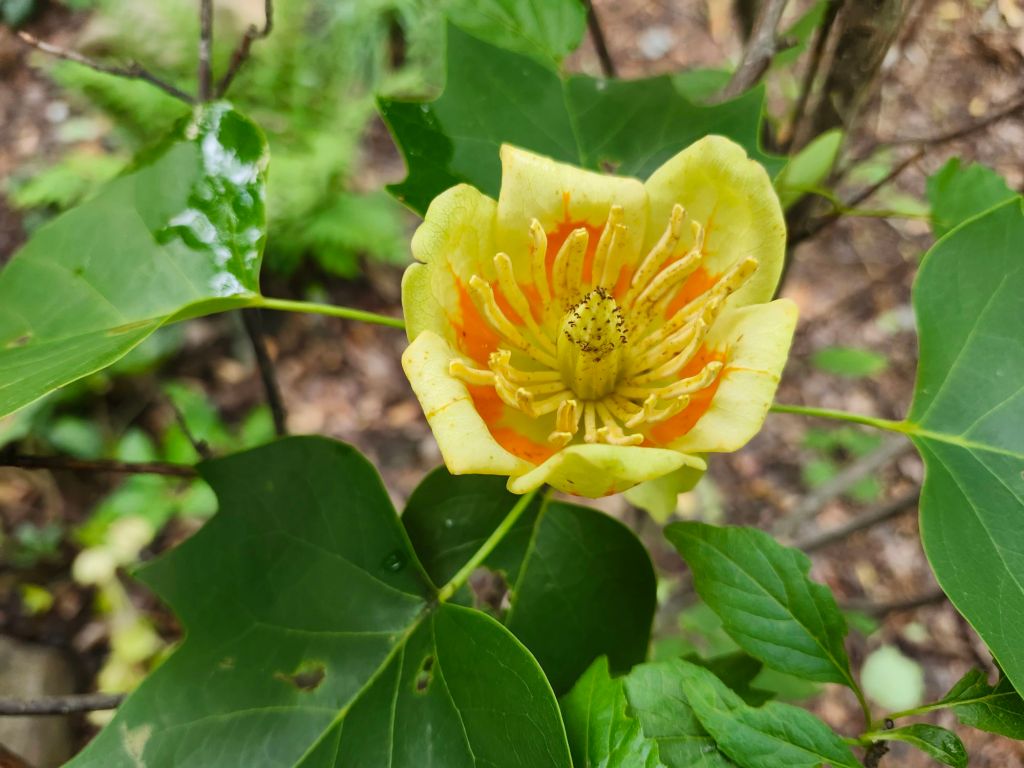
As is, flowers of the towering tulip poplars are far too high to be observed except on occasions when branch tips are broken and drop to the ground. Flowers are often intact despite the fall that is likely eased by a parachute of attached leaves, and while the blooms are not exceptional in color, the heavy, waxy flowers are quite interesting.
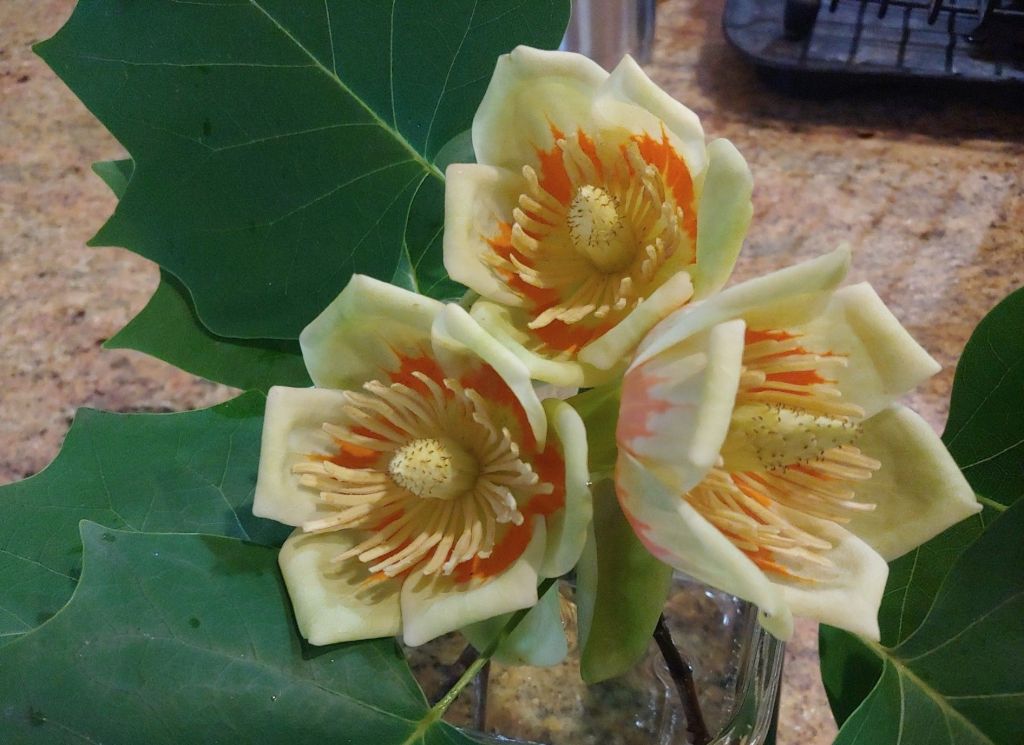
While its leaves are glossy and distinct in their shape, the autumn foliage color of tulip poplar is an unremarkable yellow which explains its relative unpopularity as a landscape tree. I have no objection to its proximity to the garden so I can enjoy the occasional bouquet.
 Ramblin' through Dave's Garden