Most plants in the garden are of humble origin, with no remarkable tale to tell. Not so Mr. Franklin’s tree, Franklinia alatamaha.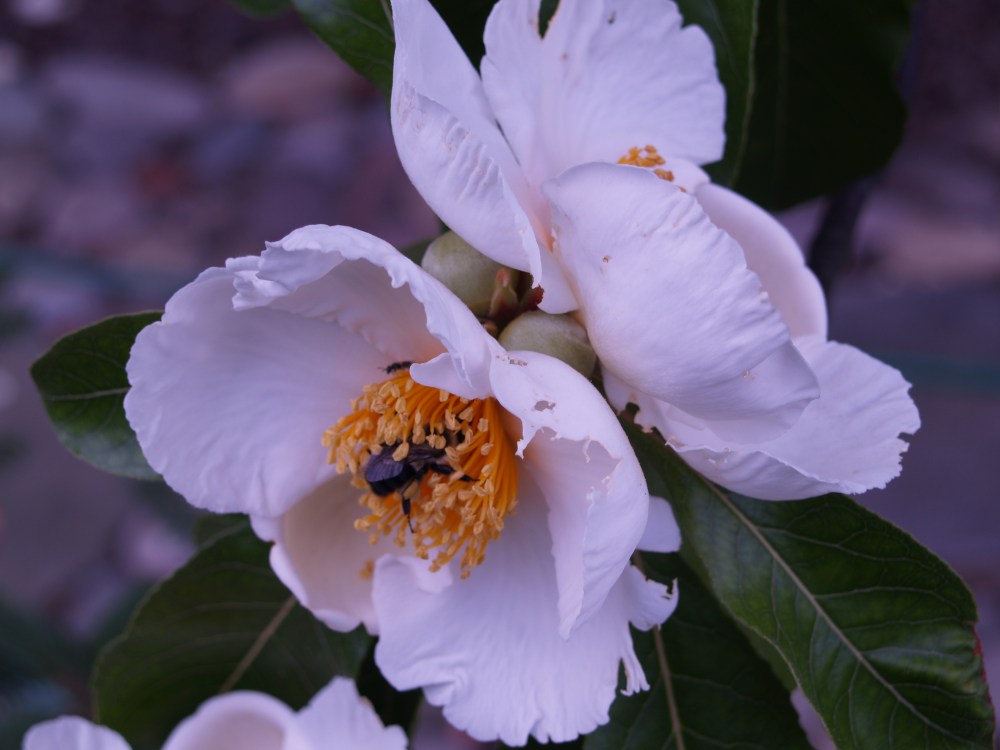
The curious large shrubs on the banks of the Altamaha River in Georgia were observed by noted botanists John and William Bartram in 1765. William Bartram collected seeds on a subsequent visit, which were cultivated and named in honor of their father’s friend, Ben Franklin. Franklinia disappeared from its native habitat a half century later, victim to development, flooding, or perhaps fungus from overplanting of cotton, so all trees in cultivation today descend from the Bartram’s seed.
The Franklinia in my garden has a similar survival story to tell.
Nearly twenty years ago I discovered mine in a tree growing nursery in the mountains of western North Carolina. I promptly purchased twenty-five of the eight foot tall trees for the landscape company I work for, Meadows Farms. The trees arrived dormant at our nursery in early March, and within days one was planted in my garden next to a newly constructed shed.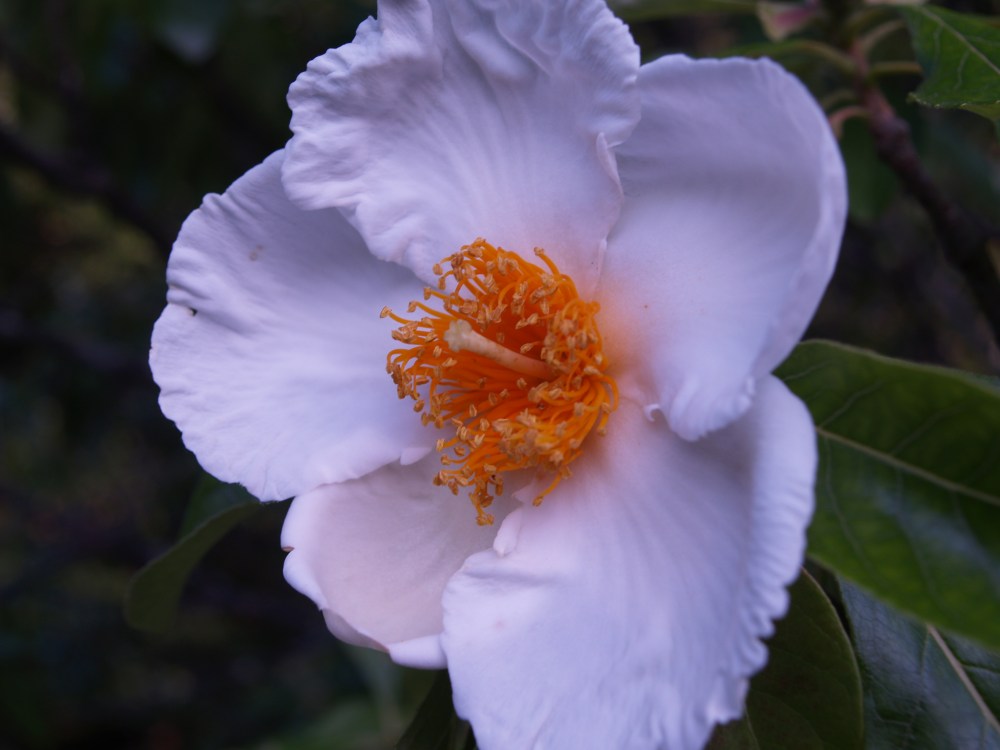
The Franklin tree has a weakly fibrous root system, and trees are difficult to transplant. The trees in the nursery began to leaf in mid April, then declined quickly with warmer temperatures. In my garden, the tree sprouted smaller than normal leaves, an indicator of problems from transplanting. Fortunately, our landscape designers had sold but a few of this uncommon tree, so few clients were disappointed when they died.
Somehow, mine survived, one of twenty-five. I have yet to see another Franklinia in a nursery in the years since, though I have seen listings for mail order trees. If you are shopping for one, I would recommend only trees grown in containers, so that the shock from transplanting is minimized.
In late July the Franklin tree is just beginning to bloom, and will continue through late September, when the leaves often begin to turn orange to scarlet. The tree is magnificent with clusters of marble sized buds opening to camellia-like three inch white flowers (also similar to Stewartia pseudocamellia).
Franklinia’s moderate size (growing to thirty feet tall and two-thirds as wide), spectacular blooms, and Fall color make it a wonderful tree for any garden.
 Ramblin' through Dave's Garden
I so enjoy (and LEARN) from checking your website routinely. I saw ONE Ben Franklin tree at a local nursery. The spot where I wanted to use it gets full sun with some pretty hot days in the summer—sometimes high nineties for a couple to several weeks. I’m good about watering. I’ve enclosed the area with blocks and a stone patio-like affair. Are the roots shallow and spreading like Magnolias? Will the Ben Franklin grow well in full sun and limited root room? The space would either be a 2 X 10 foot stretch or put in a 6 foot diameter contained circle. I live near the mountains in western Washington—-I believe they say we’re zone 8 but I choose plants that can sustain hotter and colder temps as we don’t get the marine influence to keep us more temperate. Thank you for your help. I really want this tree!!
Unquestionably, buy the tree! I don’t see any cultural issues that would prevent Franklinia from thriving in your area. In my Virginia garden it withstands prolonged heat, rainfall, and occasional drought with ease. In our heavy clay soils trees with shallow roots are very apparent, and Franklinia’s are not, so I don’t see an issue with its proximity to a patio. In fact, mine is planted in a six to seven foot width area between my shed and a stone path.
My only word of caution is to give it loving care through this first spring and summer since Franklinias have a sparse fibrous root system and are a bit difficult to transplant.
I purchased a fraknlin tree from a local nursery and planted it in September. It is now mid May and there are no leaves. I can see some green layer within its branches when I scratch off some of the outer bark. Is the tree dead or do I need to wait and see?
Franklinia is notoriously difficult to transplant, and the green bark but not leafing is what I would expect from a tree that doesn’t have sufficient roots to survive. If you hold out a bit longer it is possible that a few leaves will emerge, and if it does then you have a chance to baby it along through a few years with a chance it will revive. But, I’m betting that it will not leaf at all. I don’t know why tree growers don’t grow Franklinia in containers so that this problem could be avoided.
What an amazing story and plant named after an amazing man, Dr Franklin! And to think with his roots, he always ended up where he was planted-Philadelphia! Great information and article, thank you!
My Franklinia ha yellow leaves starting in a few places. IT was planted in this past spring, What causes this?
Yellowing leaves are not unusual in summer. In my garden birch and serviceberry drop significant numbers pf leaves in July. This would be lessened with regular irrigation.
Can you prune the top branches of the tree? We have had ours for almost 4 years with the best smelling flowers in August. This year though after a long winter season in southern oregon it is struggling and leafing late mid May. Very few leafs out. From the top center there are 2, 4 ft branches higher than rest of tree. Is it safe to remove those two? It did come in container when we first planted. We purchased at local nursery. I love this tree and his name is Ben. I name all my trees 🙂
With limited foliage, I would prune only to remove dead wood. Leaves are important for the tree to regain strength